

Industry



0102030405
Bathroom Accessory Finishing: Towel Bars, Hooks, and More
2026-10-13
Why Bathroom Accessory Finishing Matters Commercially
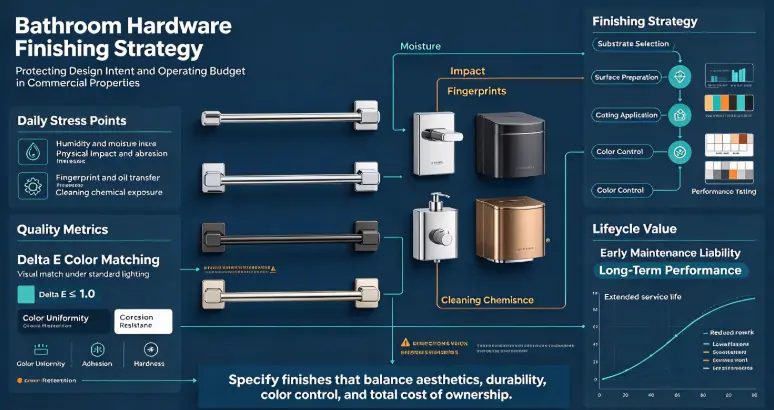
The commercial viability of hospitality, multifamily, and institutional developments relies heavily on the durability and aesthetics of interior fixtures. Bathroom accessory finishing serves as a critical touchpoint, bridging the gap between architectural design intent and daily operational realities. For procurement professionals and asset managers, the finish applied to towel bars, robe hooks, and paper dispensers is not merely a decorative choice, but a functional barrier protecting the underlying substrate from a highly corrosive environment.
In high-traffic commercial applications, the physical environment of a bathroom presents constant threats to hardware integrity, including high humidity, fluctuating temperatures, and exposure to aggressive cleaning chemicals. Consequently, the specification of these finishes carries significant financial implications, influencing both initial capital expenditures and long-term maintenance budgets.
Impact on Perceived Quality
Perceived quality in commercial spaces is heavily dictated by tactile feedback and visual uniformity. When end-users interact with a towel bar or a grab bar, the smoothness, weight, and visual depth of the finish immediately communicate the overall caliber of the facility. In luxury commercial builds, a rejection rate exceeding 2% for micro-pitting, blistering, or uneven plating can disrupt project timelines and damage brand reputation. Consistent, high-quality finishes assure users of the property's premium status and rigorous maintenance standards.
Role in Design Consistency
Achieving design consistency requires stringent color matching, particularly when integrating accessories with plumbing fixtures manufactured by different vendors. Discrepancies in a brushed nickel or matte black finish can visually fragment a space. To combat this, elite manufacturers utilize spectrophotometers to ensure color variance remains tightly controlled, typically requiring a Delta E (ΔE) value of less than 1.5 across different production batches. This quantitative approach to color matching ensures that a towel ring purchased in one quarter perfectly matches a shower basket procured in the next.
Influence on Long-Term Value
Asset managers typically amortize commercial bathroom fixtures over a 5- to 7-year lifecycle. Inferior finishes that corrode, flake, or tarnish prematurely force early capital expenditures and increase labor costs associated with replacement. By investing in highly durable finishing processes, properties can extend the operational life of their accessories, directly improving the net operating income. The long-term value of a meticulously finished accessory lies in its ability to withstand daily abuse while maintaining its factory-grade appearance without requiring specialized restorative maintenance.
What Bathroom Accessory Finishing Means in Manufacturing
Understanding the manufacturing processes behind bathroom accessory finishing is essential for supply chain and procurement professionals. The chosen methodology dictates the physical properties, environmental resistance, and unit economics of the hardware. Modern manufacturing leverages a combination of traditional chemistry and advanced vacuum technologies to bond decorative layers to raw substrates, often adhering to strict international guidelines such as those published by the ISO.
Substrates, Plating, and Coatings
The integrity of any finish is fundamentally dependent on the underlying substrate. Zinc die-cast (Zamak), brass, and 304 or 316 stainless steel are the industry standards. For non-ferrous substrates like Zamak or brass, the finishing process typically begins with a copper strike to ensure adhesion, followed by 10 to 15 microns of nickel plating. This substantial nickel layer provides the primary corrosion resistance and leveling properties before the final micro-layer of decorative chrome, gold, or custom alloy is applied via electroplating or physical vapor deposition (PVD).
Finish Codes, Gloss Levels, and Color Ranges
Finish codes standardize expectations across the global supply chain, ensuring that a "Brushed Bronze" specified in North America matches the output of a facility in Asia. Beyond color, gloss levels are strictly measured and monitored. For instance, a true matte black finish typically registers between 10 and 20 Gloss Units (GU) when measured at a 60-degree angle with a gloss meter. Deviations outside this 10-GU threshold result in finishes that appear either too chalky or unintentionally semi-gloss, highlighting the need for rigorous quantitative quality control.
Texture and Surface Consistency
Surface consistency relies heavily on the preparation of the raw material before any coating is applied. Pre-plating polishing must achieve a surface roughness (Ra) of less than 0.2 microns. If the substrate is insufficiently polished, the subsequent layers of nickel and chrome will amplify the microscopic scratches and pits rather than conceal them. Advanced techniques like PVD offer exceptional surface consistency by vaporizing solid metal in a vacuum and depositing it atom by atom, resulting in a uniform, highly dense layer that perfectly conforms to the polished substrate's texture.
How to Compare Bathroom Accessory Finishing Options
Selecting the optimal finish requires balancing aesthetic trends with rigorous performance metrics. Procurement teams must evaluate finishes based on empirical data and lifecycle cost analysis rather than visual appeal alone. The market offers a wide spectrum of finishing technologies, each with distinct advantages and inherent vulnerabilities when exposed to commercial bathroom environments.
Chrome, Brushed Nickel, Matte Black, and Specialty Finishes
The commercial market is dominated by a core group of finishes, supplemented by trending specialty colors. Chrome remains the baseline for affordability and widespread availability, while brushed nickel offers superior fingerprint resistance for high-touch accessories. Matte black, typically achieved via powder coating or electrophoretic deposition (E-coating), requires careful specification to avoid chipping.
| Finish Type | Typical Process | Durability / Hardness | Relative Cost Index |
|---|---|---|---|
| Polished Chrome | Electroplating | High | 1.0 (Baseline) |
| Brushed Nickel | Electroplating + Brushing | High | 1.15 - 1.25 |
| Matte Black | Powder Coat / E-Coat | Moderate to High | 1.20 - 1.35 |
| Brushed Brass | PVD (Physical Vapor Deposition) | Very High | 1.40 - 1.70 |
Corrosion Resistance and Scratch Performance
Corrosion resistance is empirically quantified through neutral salt spray (NSS) testing, a standard metric in global manufacturing. Standard electroplated chrome on a brass or zinc substrate must typically withstand a minimum of 96 hours of continuous NSS exposure without exhibiting signs of red rust or blistering. In contrast, high-grade PVD finishes or marine-grade 316 stainless steel accessories are engineered to exceed 200 to 250 hours of salt spray exposure, making them imperative for coastal properties or highly aggressive healthcare environments.
Cost Drivers for Towel Bars and Accessories
The finishing process is a primary cost driver in accessory manufacturing, often accounting for 30% to 45% of the total unit production cost of a towel bar or robe hook. While electroplated chrome is highly scalable and cost-effective, custom finishes introduce significant economic variables. Specialized PVD colors or custom powder-coated matches generally command a Minimum Order Quantity (MOQ) of 500 to 1,000 units to offset the substantial setup costs associated with vacuum chamber calibration and color-matching iterations.
How to Improve Bathroom Accessory Finishing Quality
Maintaining high yield rates and ensuring reliable field performance necessitates a robust quality assurance framework throughout the supply chain. Defective finishes not only disrupt construction schedules but also inflate installation costs and trigger complex warranty disputes. Proactive quality control must begin at the factory level and extend through the final installation phase.
Supplier Qualification for Finish Consistency
Effective supplier qualification must focus on the stability of a manufacturer's plating baths, their environmental compliance, and their internal defect management. Buyers should mandate strict inspection criteria during factory audits, typically enforcing an Acceptable Quality Limit (AQL) of 1.5 for major defects (such as deep scratches or exposed substrate) and 2.5 for minor visual inconsistencies (such as slight water spots or edge discoloration). Suppliers must also demonstrate robust wastewater treatment capabilities to ensure long-term operational viability and compliance with global environmental standards.
Sample and Production Inspection Checkpoints
Production inspections rely on non-destructive testing methodologies to verify finish integrity before shipment. X-ray fluorescence (XRF) testing is routinely utilized to measure plating thickness down to the nanometer, ensuring the critical nickel layer meets the specified 10 to 15-micron threshold. Additionally, cross-hatch adhesion tests (such as ASTM D3359) are performed on randomly sampled powder-coated or painted accessories to guarantee that the finish will not delaminate or flake when subjected to mechanical stress or thermal cycling.
Installation Practices That Prevent Finish Damage
Improper handling during the final stages of construction is a leading cause of finish failure, often misattributed to manufacturing defects. Harsh, acidic post-construction cleaning agents used to remove grout haze can instantly strip protective lacquers and permanently etch electroplated finishes. Furthermore, scratch damage from improper tool use or careless handling during the mounting process accounts for an estimated 15% to 20% of all bathroom accessory punch list defects. Implementing strict site-protection protocols and mandating the use of neutral pH cleaners are critical steps in preserving finish integrity.
How Project Teams Should Choose the Right Finish
The specification of bathroom accessories must be a calculated decision integrating architectural vision, facility maintenance protocols, and capital budgets. Project teams cannot afford to treat accessory finishes as an afterthought; the selected coating must align precisely with the operational demands of the specific commercial sector.
Balancing Design Intent, Durability, and Budget
Balancing design intent with budget constraints requires a nuanced approach to lifecycle cost analysis. While advanced PVD finishes carry a 20% to 30% upfront cost premium over standard electroplating, their superior resistance to scratching, tarnishing, and chemical degradation significantly lowers total lifecycle costs. For high-traffic environments, investing the initial premium in PVD or heavy-duty powder coating prevents the labor and material costs associated with replacing degraded towel bars and hooks within the first three years of operation.
Finish Selection for Hospitality, Multifamily, Healthcare, and Commercial Projects
Different commercial sectors dictate vastly different finishing requirements based on user behavior and maintenance regimens.
| Sector | Recommended Substrate | Preferred Finish Technology | Key Specification Driver |
|---|---|---|---|
| Healthcare | 304 / 316 Stainless Steel | Polished / Antimicrobial Coating | Bleach and chemical resistance |
| Hospitality (Luxury) | Solid Brass | PVD (Gold, Bronze, Brass) | Aesthetic longevity and high durability |
| Multifamily | Zinc Die-Cast (Zamak) | Electroplated Chrome / Nickel | Cost-efficiency and standardization |
| Commercial Office | Stainless Steel | Brushed / Satin Finish | Fingerprint resistance and low maintenance |
Final Specification Checklist for Approval
To mitigate risk, the final specification package must include physical master samples, signed and dated by both the manufacturer and the lead architect, serving as the definitive benchmark for all production runs. The specification checklist must clearly define acceptable variance tolerances (e.g., maximum ΔE limits for color) and verify warranty terms. Project teams should insist on a minimum 1-year commercial warranty against flaking, peeling, and abnormal discoloration, ensuring the manufacturer stands behind the chemical and mechanical integrity of their finishing process.
Key Takeaways
- Specify finishes as functional corrosion barriers, not just decorative surfaces, because commercial bathrooms expose hardware to humidity, temperature swings, and aggressive cleaning chemicals.
- Use measurable quality controls such as Delta E values below 1.5 to keep brushed nickel, matte black, and other finishes consistent across production batches.
- Monitor defects such as micro-pitting, blistering, and uneven plating because rejection rates above 2% can affect timelines in premium commercial projects.
- Choose substrates such as Zamak, brass, 304 stainless steel, or 316 stainless steel based on the required balance of adhesion, durability, corrosion resistance, and cost.
- Plan accessory finishing around a 5- to 7-year asset lifecycle to reduce premature replacement, maintenance labor, and total cost of ownership.
Frequently Asked Questions
Why does the finish on bathroom accessories matter in commercial projects?
Finishing protects towel bars, hooks, grab bars, and dispensers from humidity, cleaning chemicals, corrosion, and wear. It also affects perceived quality, design consistency, and long-term replacement costs in hospitality, multifamily, and institutional facilities.
What finish issues can delay a commercial bathroom project?
Micro-pitting, blistering, uneven plating, color mismatch, flaking, and premature tarnish can trigger rejections. In luxury projects, rejection rates above 2% may disrupt installation schedules and damage brand perception.
How is color consistency controlled across accessory batches?
High-quality manufacturers use spectrophotometers to measure color variance. For premium finishes such as brushed nickel or matte black, a Delta E value below 1.5 helps ensure accessories from different batches visually match.
Which substrates are commonly used for finished bathroom accessories?
Common substrates include zinc die-cast alloys such as Zamak, brass, and 304 or 316 stainless steel. The substrate affects finish adhesion, corrosion resistance, strength, and total product lifespan.
How long should commercial bathroom accessories typically last?
Asset managers often plan around a 5- to 7-year lifecycle. Durable finishing can help accessories maintain appearance and function throughout that period, reducing early replacement and maintenance costs.