
Industry

0102030405
Manual vs Automatic Deburring: Total Cost of Ownership Analysis
2026-10-13
Manual vs Automatic Deburring: Decision Framework
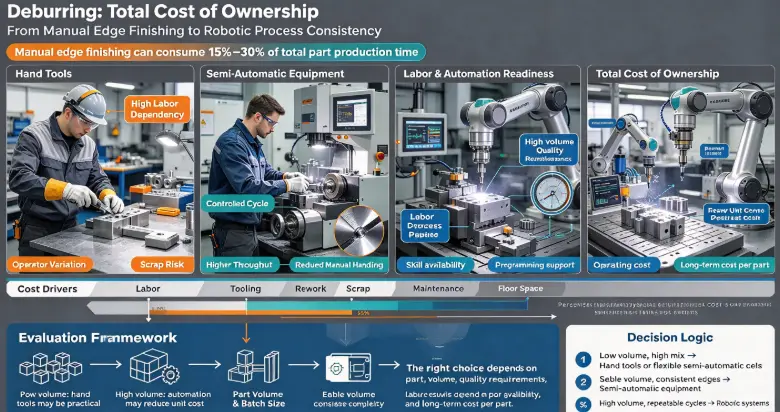
Evaluating manual versus automatic deburring requires a comprehensive Total Cost of Ownership (TCO) analysis. While removing burrs and sharp edges is a mandatory finishing step in metalworking and plastics manufacturing, the method chosen profoundly impacts operational efficiency and production scalability.
Why Deburring Method Selection Matters
The selection of a deburring method directly influences final part quality, downstream assembly tolerances, and overall manufacturing bottlenecks. In high-precision sectors such as aerospace and medical device manufacturing, manual deburring can account for a significant portion of total part production time—often estimated between 15% and 30%. Relying on human operators introduces inherent variability, which can lead to over-chamfering or missed burrs, elevating scrap rates for complex geometries. Implementing standardized quality management systems, often guided by frameworks like ISO 9001 or ISO 13485, requires consistent edge finishing that manual processes struggle to guarantee at high volumes. However, manual deburring remains highly effective for prototyping, extreme part variability, and certain delicate geometries where human adaptability is required.
Key Cost Categories to Compare
A robust TCO analysis must evaluate more than just the initial price tag of a robotic cell or the hourly wage of a technician. Key cost categories include upfront Capital Expenditure (CapEx), ongoing Operational Expenditure (OpEx) such as abrasive media and tooling replacements, labor burdens including benefits and turnover, and hidden costs like rework and scrap. By mapping these cost factors, facility managers can accurately quantify the true cost per part over a standard 5- to 10-year equipment lifecycle.
Process Definitions and Boundaries
To accurately compare costs and performance, manufacturers must establish clear process boundaries defining where primary machining ends and deburring begins.
Manual, Semi-Automatic, and Automatic Deburring
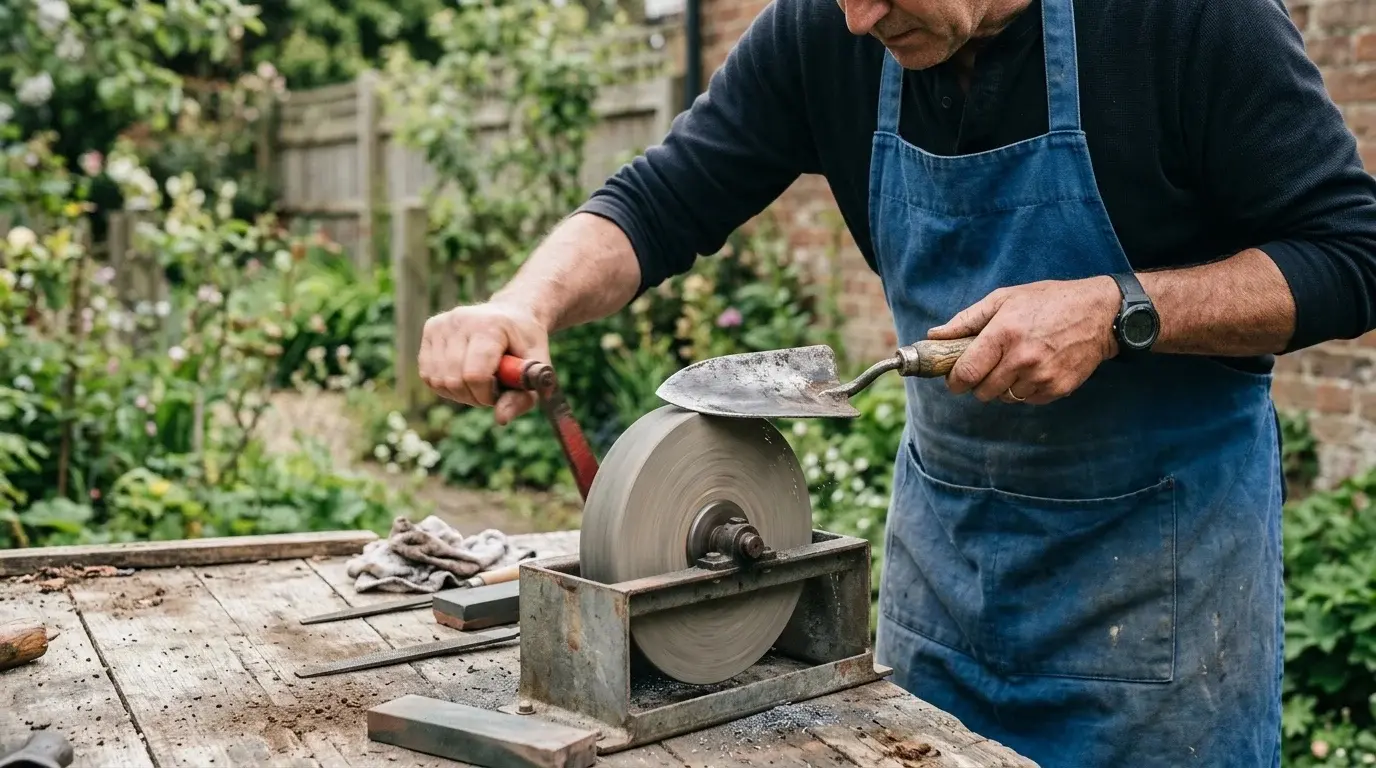
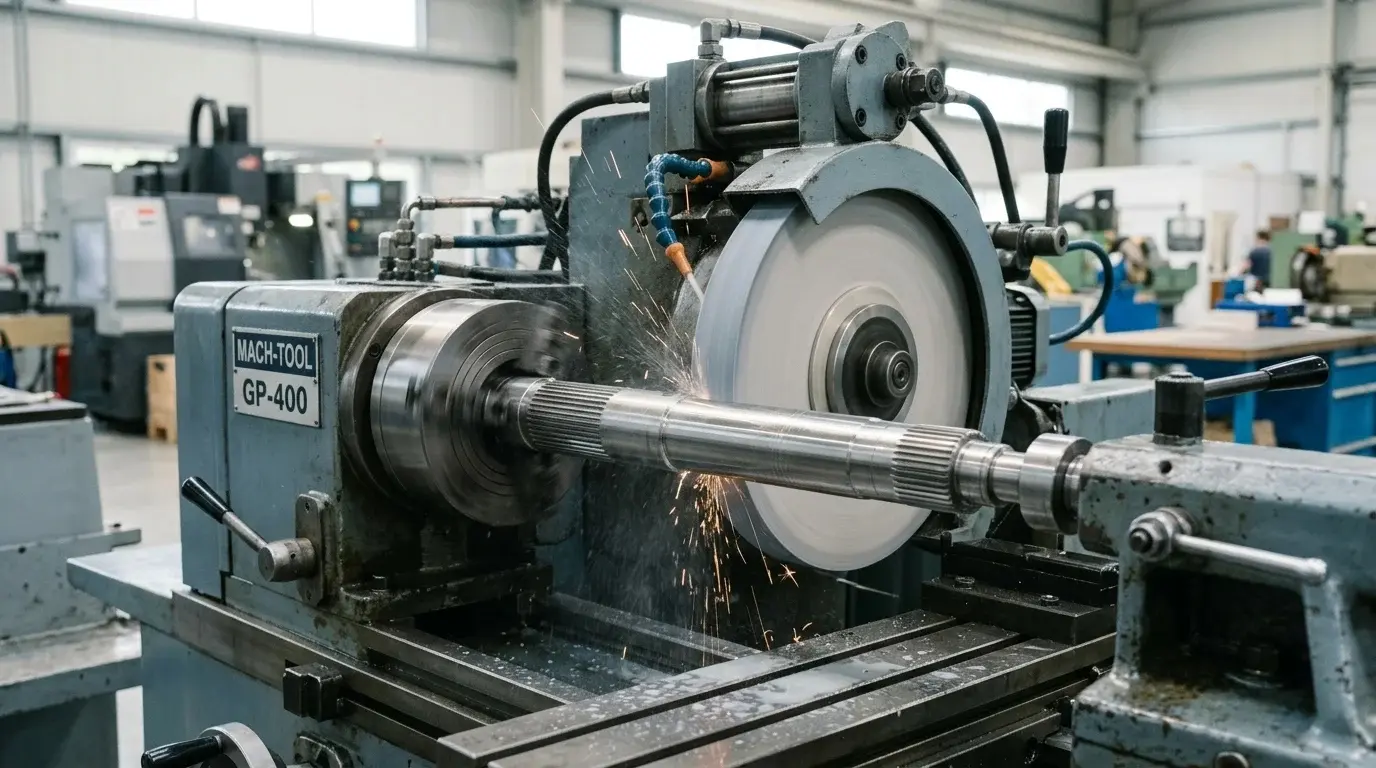
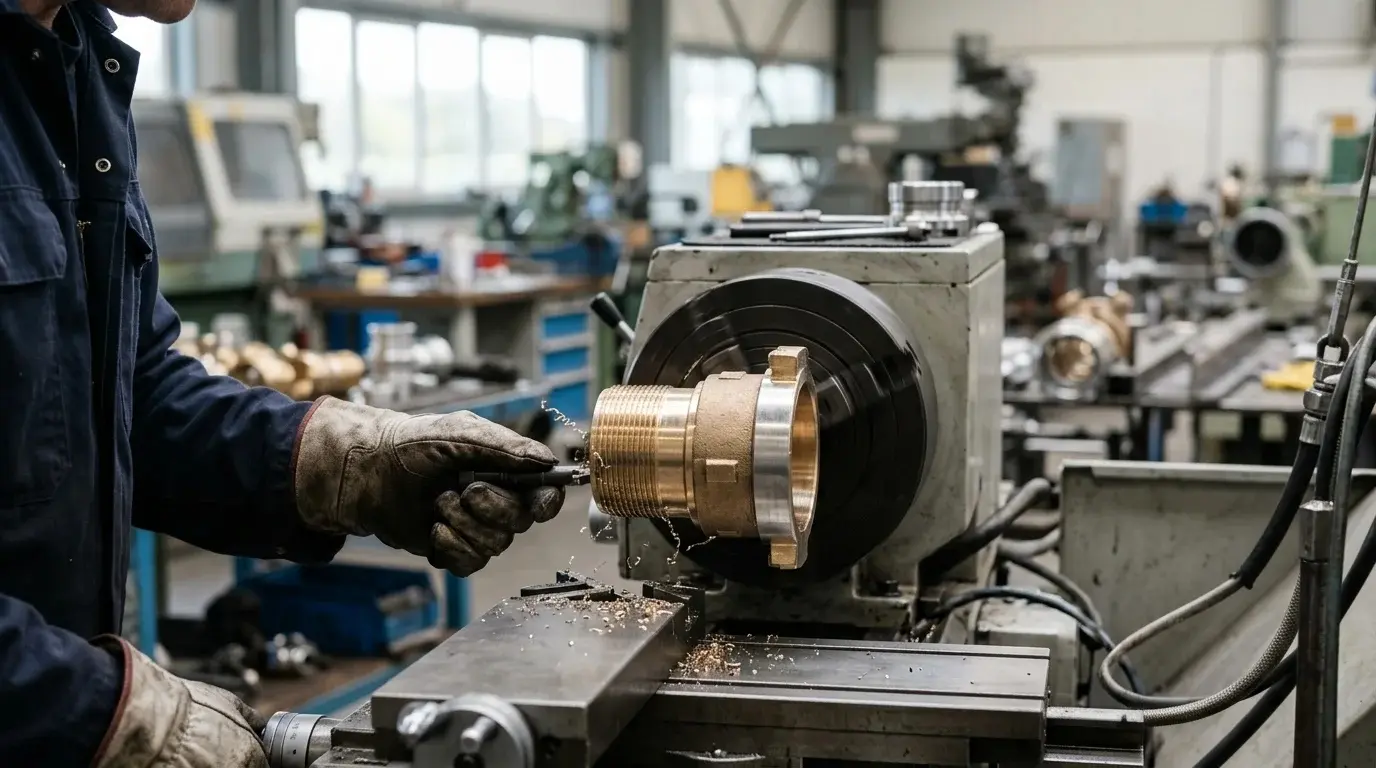
Manual deburring relies on technicians using hand tools, pneumatic grinders, or abrasive pads to remove edge imperfections. Semi-automatic methods introduce batch processing equipment, such as vibratory tumblers or centrifugal barrel finishers, which process multiple parts simultaneously but still require manual loading, unloading, and cycle monitoring. Semi-automatic methods are often the optimal middle ground for medium-volume production runs where parts share similar tumbling requirements but do not justify the cost of full robotics. Fully automatic deburring utilizes CNC machines or 6-axis robotic arms equipped with compliant spindles to trace part edges with exact programmed precision, entirely removing the operator from the active cutting cycle.
| Method | Capital Cost Range | Cycle Time Consistency | Ideal Batch Size |
|---|---|---|---|
| Manual | $100 - $1,500 | Low | 1 - 500 (Low Volume) |
| Semi-Automatic | $5,000 - $40,000 | Medium | 500 - 5,000 (Medium Volume) |
| Automatic (Robotic) | $80,000 - $250,000 | High | 5,000+ (High Volume) |
Part Features, Materials, and Burr Types
The technical feasibility of transitioning to automation depends heavily on part morphology and material properties. Burr types—such as Poisson burrs, rollover burrs, and breakout burrs—present varying levels of resistance based on the thickness of the burr at its base, known as root thickness. This dimension typically ranges from 0.05 mm to 0.5 mm in precision machining. Material hardness is an equally critical boundary condition. Removing a 0.2 mm rollover burr from 6061 aluminum requires significantly less cutting force and tooling durability than extracting the exact same burr profile from Inconel 718 or titanium Grade 5.
Cost Comparison and Payback
Transitioning from manual to automated deburring fundamentally shifts the financial model from high variable costs driven by labor to high fixed costs driven by capital equipment.
Capital, Labor, Tooling, and Maintenance Costs
In a manual setup, a facility might pay a fully burdened labor rate of $35 to $50 per hour per operator. Over a standard two-shift operation, annual labor costs can easily exceed $140,000 for a single manual deburring station. Conversely, an automated robotic deburring cell requires a substantial initial CapEx investment ranging from $100,000 to $250,000. However, the automated cell operates with minimal human intervention, dramatically lowering ongoing labor expenses. Tooling costs also shift; automated compliant spindles extend abrasive lifespan by maintaining constant contact force, reducing consumable spend notably compared to inconsistent manual grinding.
Scrap, Rework, Inspection, and Ergonomic Risk
Manual deburring carries significant hidden costs related to human error and physical strain. Repetitive Strain Injury (RSI) claims, worker fatigue, and high turnover rates in finishing departments generate substantial indirect costs. Furthermore, manual inconsistencies lead to elevated scrap and rework rates. If an illustrative batch of 1,000 parts valued at $50 each experiences a 3% scrap rate due to manual over-machining, the facility loses $1,500 per batch. Automated deburring virtually eliminates ergonomic risks and standardizes edge profiles, driving scrap rates down to near-zero levels and drastically reducing the need for secondary manual inspection.
When Automation Payback Becomes Attractive
The tipping point for automation payback generally occurs when the annual savings in labor, scrap reduction, and consumables eclipse the initial CapEx within a 1.5- to 2.5-year window. For example, if an automated cell costs $150,000 to integrate and generates combined annual savings of $85,000 across labor and scrap reduction, the payback period is approximately 21 months. After crossing this threshold, the automated system generates pure margin improvement for the remainder of its operational lifecycle.
Building a Reliable Cost Model
Building a reliable cost model requires empirical data rather than theoretical estimates. Manufacturers must audit their existing processes to establish an accurate, data-driven baseline.
Measuring Current Deburring Cycle Time
The first step in building a TCO model is conducting rigorous time studies on the current manual process. Facilities must measure not just the active deburring time, but the total floor-to-floor cycle time, including part handling, tool changes, and visual inspection. If an operator takes an average of 4.5 minutes to physically deburr a cast iron engine block, but handling and inspection add another 2.5 minutes, the true cycle time is 7.0 minutes. Calculating the Overall Equipment Effectiveness (OEE) of the manual station provides the critical baseline against which automated throughput will be measured.
Validating Automation Assumptions with Trials
Before committing capital to an automated system, assumptions must be validated through physical trials. Proof of Concept (PoC) testing involves sending sample parts to an automation integrator to verify cycle times and edge finish quality under production conditions. These trials determine the necessary tooling specifications, such as whether a 30,000 RPM pneumatic spindle or a high-torque electric spindle is required to handle the specific burr root thickness. Validating these parameters ensures that the estimated automated cycle time—which is frequently faster than manual processing—is actually achievable.
Running Sensitivity Analysis for Volume Changes
A robust cost model must account for future production fluctuations. Running a sensitivity analysis helps determine the financial viability of automation under various volume scenarios. The table below illustrates a hypothetical 5-year TCO comparison, assuming a baseline fully burdened manual operator cost of $35,000 per year for the lowest volume tier, scaling up proportionally with production demands.
| Production Volume (Parts/Year) | Manual TCO (5 Years) | Automated TCO (5 Years) | Primary Cost Advantage |
|---|---|---|---|
| 10,000 | $175,000 | $220,000 | Manual (+$45,000) |
| 50,000 | $875,000 | $380,000 | Automated (+$495,000) |
| 100,000 | $1,750,000 | $580,000 | Automated (+$1,170,000) |
As demonstrated, lower volumes or highly variable prototype runs may not justify the CapEx of automation. However, once production crosses a specific breakeven threshold—often around 30,000 to 50,000 parts annually, depending on part complexity—the automated TCO becomes overwhelmingly favorable.
Choosing the Right Deburring Strategy
The ultimate decision between manual and automatic deburring hinges on aligning the TCO analysis with the strategic, long-term goals of the manufacturing facility.
Decision Matrix Factors for Quality and Throughput
Quality requirements often force the transition to automation even before strict volume thresholds are met. In a decision matrix, manufacturers must weigh the importance of process capability. Automated deburring systems consistently achieve a Process Capability Index (Cpk) greater than 1.33, ensuring that approximately 99.99% of parts (or roughly 63 defects per million) fall within tight edge-break tolerances. When a manufacturing contract demands strict adherence to global quality standards referenced by organizations like ISO, the repeatability of a robotic spindle outranks the flexibility of a manual operator.
Roadmap for Transitioning from Manual to Automatic
Transitioning to automation should follow a structured, phased roadmap. Facilities typically begin by automating the deburring of their highest-volume, highest-margin part families, allowing skilled human operators to focus on low-volume, complex legacy parts. This phased approach mitigates integration risk and allows the in-house maintenance team to develop proficiency in programming and servicing the robotic cell. Standardizing part fixturing and adopting quick-change automated tooling can reduce setup times significantly, further enhancing the flexibility of the new system.
Final Criteria for Lowest-Risk Total Cost
Rather than simply defaulting to the lowest upfront price, the lowest-risk TCO strategy balances initial capital outlay with long-term process stability. To synthesize the decision-making process, facility managers should evaluate the following actionable criteria:
- Assess Labor Availability: If manual deburring relies on a shrinking pool of skilled labor, the risk of production bottlenecks increases annually, favoring automation.
- Evaluate Part Variability: Retain manual or semi-automatic processes for prototyping, low-volume runs, or highly delicate geometries where human adaptability is paramount.
- Conduct Empirical Time Studies: Base all cycle-time assumptions on actual floor-to-floor measurements rather than theoretical estimates.
- Calculate Fully Burdened Costs: Ensure the payback period accounts for hidden manual costs, including scrap reduction, consumable savings, and ergonomic liabilities.
By systematically evaluating these factors, manufacturers can confidently deploy a deburring strategy that maximizes profitability and operational resilience over the equipment's lifecycle.
Key Takeaways
- Compare manual, semi-automatic, and robotic deburring using total cost per part over a 5- to 10-year equipment lifecycle, not just upfront purchase cost.
- Manual deburring is cost-effective for prototypes and low-volume work, but it can consume 15% to 30% of production time in high-precision manufacturing.
- Semi-automatic deburring is often the best fit for medium-volume batches of 500 to 5,000 parts when geometries and finishing requirements are similar.
- Robotic deburring typically becomes most attractive for high-volume production above 5,000 parts where repeatability, labor reduction, and scrap control matter.
- Include hidden costs such as rework, scrap, operator turnover, abrasive consumption, maintenance, and quality inspection when building a deburring TCO model.
- Part geometry, material, burr type, and tolerance requirements should be validated before investing in automatic deburring equipment.
Frequently Asked Questions
When is manual deburring the better choice?
Manual deburring is best for prototypes, low-volume batches, highly variable parts, and delicate geometries where operator judgment is valuable. It has low upfront cost but can become expensive as labor, inconsistency, rework, and throughput limits increase.
At what production volume does automatic deburring make sense?
Automatic deburring is typically strongest at 5,000+ parts or where repeatability, tight tolerances, and stable part families justify the investment. A TCO model over 5 to 10 years should compare equipment cost against labor savings, scrap reduction, and cycle consistency.
What costs should be included in a deburring TCO analysis?
Include capital equipment, tooling, abrasives, maintenance, labor burden, training, programming, floor space, energy, rework, scrap, downtime, and quality inspection. The goal is to calculate true cost per part, not just purchase price or hourly wage.
How does robotic deburring improve quality?
Robotic deburring uses programmed paths, compliant spindles, and controlled process parameters to produce consistent edges. This reduces operator variability, missed burrs, and over-chamfering, which is especially important in regulated sectors such as aerospace and medical devices.
Is semi-automatic deburring a good middle ground?
Yes. Vibratory tumblers, centrifugal finishers, and similar systems can be cost-effective for medium-volume runs, especially when parts share similar finishing requirements. They reduce manual effort but still require loading, unloading, and process monitoring.